TonicNest may earn a commission if you buy through links on this page, at no extra cost to you. That does not change what we report.
Part of our Ikaria Lean Belly Juice overview. Last checked October 19, 2026.
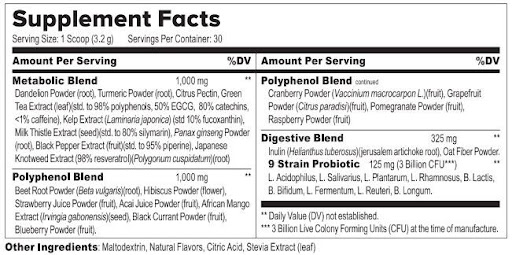
Ikaria Lean Belly Juice ingredients are split across four proprietary blends in one 3.2 g scoop, and the label gives only each blend's total weight. The Metabolic and Polyphenol blends hold 1,000 mg each, the Digestive Blend 325 mg and the probiotic 125 mg.[1] Other ingredients are maltodextrin, natural flavors, citric acid and stevia extract. The sales page highlights 8 "star" ingredients and skips turmeric, inulin, oat fiber and the probiotics.[2]
Ikaria Lean Belly Juice ingredients at a glance
No ingredient amount is disclosed, and no ingredient earns better than a weak grade for weight. Fruit powders and oat fiber have no evidence file with us and are listed as ungraded minor blend items.
| Ingredient | Role claimed | Amount disclosed? | Evidence grade (weight) |
|---|---|---|---|
| Green tea extract (50% EGCG) | Metabolism | No, Metabolic Blend | Weak |
| Kelp extract (10% fucoxanthin) | Metabolism | No, Metabolic Blend | Weak |
| Panax ginseng, milk thistle, dandelion, turmeric, citrus pectin | Metabolism, liver | No, Metabolic Blend | Weak |
| Black pepper extract (95% piperine) | Absorption | No, Metabolic Blend | Weak |
| Resveratrol (Japanese knotweed) | Fat mass | No, Metabolic Blend | Weak |
| African mango, beet, cranberry, pomegranate, grapefruit | Antioxidant | No, Polyphenol Blend | Weak |
| Hibiscus, strawberry, acai, black currant, blueberry, raspberry | Antioxidant | No, Polyphenol Blend | Not graded |
| Inulin; oat fiber | Digestion | No, Digestive Blend | Weak; not graded |
| 9-strain probiotic | Gut | Blend total only (3 billion CFU) | Weak |
What is in each ingredient, and what does research say?
Each ingredient below has a short note on human research for weight. Because all doses are hidden, none can be compared with the amounts studied.
Green tea extract
Standardized to 50% EGCG with under 1% caffeine. A Cochrane analysis found small, non-significant weight loss that was not clinically important.[3] Grade: weak, with a liver caution for extracts. Its share of the 1,000 mg blend is unknown, so the EGCG per scoop cannot be worked out.
Kelp extract (fucoxanthin)
The NIH Office of Dietary Supplements counts one weight trial, of a branded fucoxanthin and pomegranate-seed oil product used with a diet, and calls the research insufficient. A 12 mg daily trial in 28 adults found only a small within-group drop.[4] Grade: weak.
African mango
One systematic review called the effect "positive but limited due to poor methodological quality".[5] Studies used 150 mg twice daily, or 300 mg a day. Here it shares a 1,000 mg blend with ten other powders, so reaching 300 mg would leave little room for the rest. Grade: weak.
Resveratrol
A meta-analysis of 19 studies found no effect on weight or BMI.[6] Grade: weak.
Black pepper extract (piperine)
Added to raise absorption of other ingredients. It has no weight data and can change how some drugs are cleared.[7] Grade: weak.
Panax ginseng, milk thistle, dandelion and turmeric
None has weight-loss evidence in our files. In milk thistle trials, liver enzyme drops occurred "irrespective of weight loss".[8] Turmeric is paired here with piperine, which raises its absorption. Grade: weak.
Citrus pectin
15 g with a meal slowed stomach emptying in 9 adults with obesity.[9] This scoop weighs 3.2 g in total, so the amount here is far lower. Grade: weak.
Beet root, cranberry, pomegranate and grapefruit
No weight evidence in our files for any of the four. Grapefruit matters for safety, since it can block a drug-clearing enzyme. Grade: weak.
Inulin
A meta-analysis of 33 trials found inulin-type fructans did not affect body weight.[10] Grade: weak.
Probiotic blend
Nine strains, 3 billion CFU at manufacture, per-strain split undisclosed. Across 15 trials, probiotics gave small weight effects.[11] We have evidence files for six of the strains. L. salivarius, L. plantarum and L. fermentum have none, so we list them as ungraded minor blend items.
Ungraded minor blend items
Hibiscus, strawberry, acai, black currant, blueberry and raspberry powders, plus oat fiber, have no evidence file with us. They are food powders, and any effect on weight loss is not established.
How transparent is the Ikaria Lean Belly Juice formula?
The label is public, which is better than many supplements, but the proprietary blends hide every dose. That blocks the one check a buyer most needs: comparing each amount with the doses in studies.
The arithmetic shows the problem. The 1,000 mg Metabolic Blend holds nine items. If they were split evenly, each would get about 111 mg. The 1,000 mg Polyphenol Blend splits across 11 items, about 91 mg each on an even split. Real splits are unknown and could be far smaller for some ingredients.
The sales page and the label also tell different stories. The sales page names 8 "star" ingredients and "8 super antioxidants" but lists only 7 of them, while the label adds turmeric, inulin, oat fiber and nine probiotic strains the sales page never mentions.[2] When the two disagree, the label is the record that counts.
Ingredient lists on third-party pages sometimes differ from the jar. Trust the Supplement Facts panel on the vendor site, read October 19, 2026, and the label on the jar you receive.[1]
Ingredient safety and interactions
Most ingredients are common foods, but five deserve a check if you take medicine: grapefruit, piperine, panax ginseng, turmeric and green tea extract. Grapefruit and piperine can both slow how the body clears some drugs, and green tea extract has been tied to uncommon liver injury.
- Kelp carries iodine, which matters for thyroid disease and levothyroxine users.
- Inulin and citrus pectin can cause gas and bloating.
- Dandelion and milk thistle can trigger allergy in people sensitive to ragweed.
Show the label to a pharmacist first. Our side effects and interactions page lists the medicine groups.
Do these ingredients prove Ikaria Lean Belly Juice works?
No. Ingredient studies tested single compounds at known doses, often with a diet, and most found small or no weight change. This formula mixes over 20 plant, fruit and fiber items with a probiotic at hidden doses, and no published trial has tested the mix.
Our evidence check walks through what can be concluded, and our how to take it guide covers the label directions.
Back to the Ikaria Lean Belly Juice overview.
Frequently asked questions
What are the main ingredients in Ikaria Lean Belly Juice?
The label lists four blends: Metabolic (green tea extract, kelp fucoxanthin, panax ginseng, milk thistle, piperine, resveratrol and others), Polyphenol (African mango, grapefruit and other fruit powders), Digestive (inulin, oat fiber) and a 9-strain probiotic.
How much green tea extract is in Ikaria Lean Belly Juice?
The amount is not disclosed. Green tea extract sits inside the 1,000 mg Metabolic Blend with eight other ingredients. The label says it is standardized to 50% EGCG with under 1% caffeine, so it is not caffeine free.
Does Ikaria Lean Belly Juice contain caffeine?
A small amount. The green tea extract on the label contains under 1% caffeine. Its share of the blend is hidden, so the exact caffeine per scoop is unknown. People sensitive to caffeine should count it alongside coffee and tea.
Are the Ikaria Lean Belly Juice ingredients natural?
Most actives are plant, fruit and fiber powders plus probiotic strains. Other ingredients are maltodextrin, natural flavors, citric acid and stevia extract. Natural does not mean safe with every medicine, since grapefruit and piperine can affect drug levels.
Where can I see the Ikaria Lean Belly Juice label?
The vendor publishes the Supplement Facts panel on theikariajuice.com, which we read October 19, 2026. Compare it with the label on the jar you receive, and do not rely on ingredient lists copied onto other websites.
Sources
- Ikaria Lean Belly Juice Supplement Facts panel. theikariajuice.com, read October 19, 2026.
- Ikaria Lean Belly Juice sales page. theikariajuice.com, read October 19, 2026.
- Cochrane systematic review: green tea for weight loss in adults with overweight or obesity (PMID 23235664). PubMed, National Library of Medicine, read October 2026.
- Trial of 12 mg daily fucoxanthin in 28 adults (PMID 37405785). PubMed, National Library of Medicine, read October 2026.
- Systematic review of Irvingia gabonensis (African mango) for weight (PMID 31855111). PubMed, National Library of Medicine, read October 2026.
- Meta-analysis of 19 studies on resveratrol and body weight (PMID 33487308). PubMed, National Library of Medicine, read October 2026.
- Piperine and blood levels of propranolol and theophylline (PMID 1815977). PubMed, National Library of Medicine, read October 2026.
- Silymarin and liver enzymes, analysis of trials (PMID 33418491). PubMed, National Library of Medicine, read October 2026.
- Pectin, gastric emptying and fullness in adults with obesity (PMID 3169489). PubMed, National Library of Medicine, read October 2026.
- Meta-analysis of 33 trials on inulin-type fructans and body weight (PMID 34401107). PubMed, National Library of Medicine, read October 2026.
- Meta-analysis of 15 randomized trials of probiotics and body weight (PMID 29047207). PubMed, National Library of Medicine, read October 2026.
This page is general information, not medical advice. Dietary supplements are not reviewed by the FDA for safety or effectiveness before they are sold and are not intended to diagnose, treat, cure or prevent any disease. Talk to your doctor before taking any supplement, especially if you are pregnant, nursing, take medication or have a health condition.